
Reality Transurfing: How to Eliminate Excess Potential and Stop Repelling Your Desires
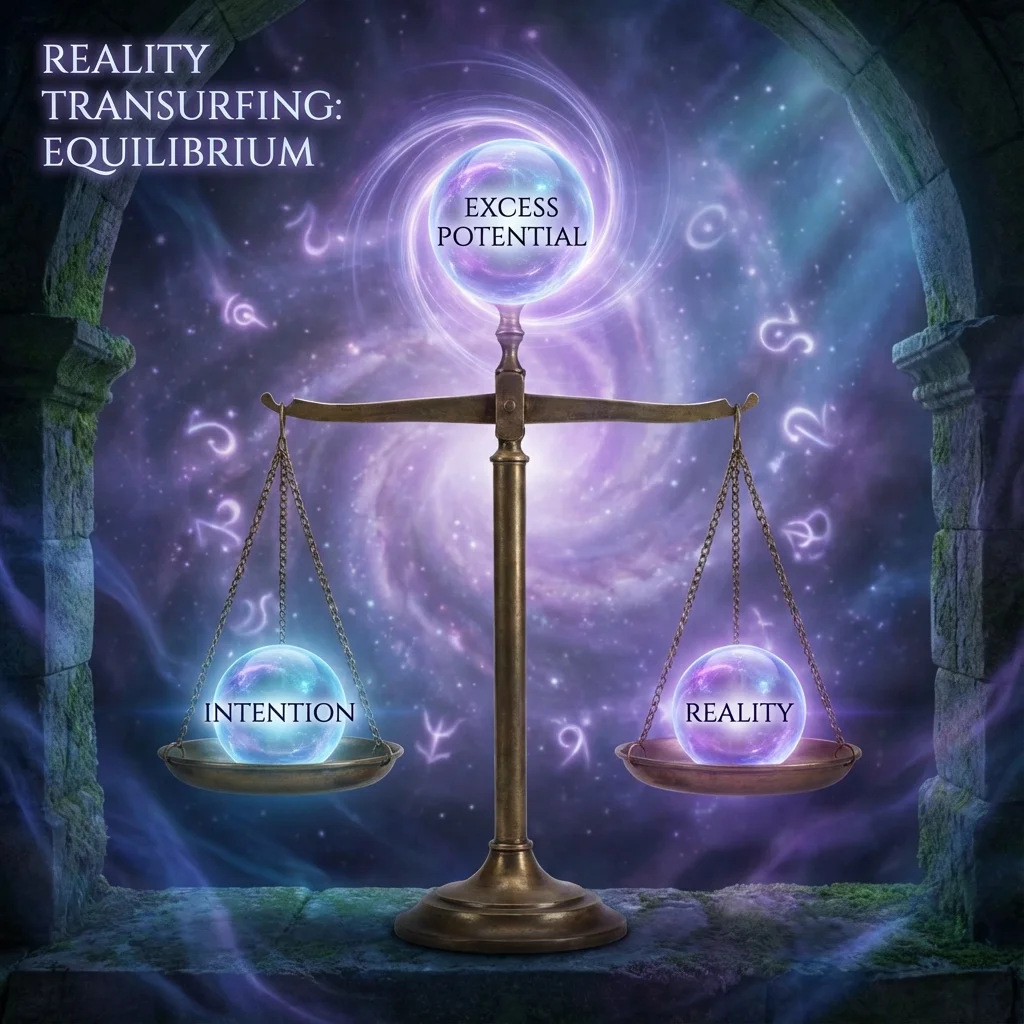
You've done everything right. Visualized with feeling. Affirmed consistently. Believed with all your heart. And yet... the harder you try, the more your desire seems to slip away. If this sounds familiar, you may be experiencing what Vadim Zeland calls "excess potential"—and it could be the invisible force sabotaging your manifestations.
What Is Reality Transurfing?
Reality Transurfing is a manifestation philosophy developed by Russian quantum physicist Vadim Zeland, presented in his multi-volume series of the same name. Unlike Law of Attraction or Neville Goddard's teachings, Transurfing draws heavily on concepts from quantum physics and introduces unique terminology and frameworks.
The core premise: reality exists as an infinite "space of variations" containing all possible outcomes. Your task isn't to create or attract—it's to navigate to the variation where your desire already exists.
What makes Transurfing distinct is its emphasis on balance. Where other systems encourage intense desire and emotional investment, Zeland warns that this very intensity can create "excess potential" that blocks manifestation.
Understanding Excess Potential
Excess potential is perhaps Transurfing's most counterintuitive concept—and arguably its most valuable contribution to manifestation theory.
The Basic Principle
When you assign excessive importance to something—whether through intense desire, fear, worry, or idealization—you create energetic imbalance. This imbalance, called excess potential, generates what Zeland calls "balancing forces" that work to restore equilibrium.
The problem? These balancing forces often work against your desire.
Think of it like squeezing sand: the tighter you grip, the more it slips through your fingers. The universe isn't punishing you—it's simply rebalancing the energy you've disturbed.
Examples of Excess Potential
Making something too important: "I NEED this job. My whole future depends on it. If I don't get it, I'm finished."
The excessive importance creates pressure. The balancing forces might manifest as unexpected interview anxiety, a competing candidate appearing, or the position being eliminated.
Idealizing an outcome: "This relationship will be absolutely perfect. They're my soulmate. Nothing could ever go wrong."
The pedestal creates instability. Reality provides contrast to balance the idealization.
Intense fear: "If I lose this money, I'll be ruined. I can't handle failure."
The fear is itself excess potential. Balancing forces may create exactly what you fear.
The paradox: The more desperately you want something, the more potential you create for it to not manifest.
This doesn't mean desire is bad—it means desperate attachment is problematic.
Why Traditional Approaches Create Excess Potential
Most manifestation systems inadvertently encourage excess potential:
"Feel it as real!" — When taken to extremes, this creates intense longing during the gap between visualization and manifestation.
"Raise your vibration!" — The pressure to maintain high emotions can create anxiety when you naturally have low moments.
"Never doubt!" — Suppressing doubt rather than processing it creates internal tension.
"Act as if!" — Forcing behaviors that don't match reality can feel fake and create internal resistance.
The issue isn't these techniques themselves—it's the intensity and attachment often applied to them. Zeland suggests a more relaxed, almost casual approach to desire.
How to Eliminate Excess Potential
Strategy 1: Reduce Importance
The primary solution: lower the significance you're assigning to your desire.
This doesn't mean stop wanting it. It means wanting it without believing your happiness depends on it.
Practice: When you notice yourself saying "I need this" or "everything depends on this," consciously reframe:
- "I'd really like this, and I'll be fine either way."
- "This is one of many good possible outcomes."
- "Getting this would be nice. Not getting it wouldn't be the end of the world."
The goal is genuine indifference to whether it happens—while still preferring that it does. This is close to what other teachers call detachment, but Transurfing frames it specifically as preventing excess potential rather than just "letting go."
Strategy 2: Balance Inner and Outer Importance
Transurfing distinguishes between:
Inner importance: How significant you make yourself ("I'm so important/unimportant") Outer importance: How significant you make external things ("This is so crucial")
Both create excess potential.
Too much self-importance: "I deserve this. I'm special. The universe owes me." Too little self-importance: "I'm not worthy. People like me don't get this."
Too much outer importance: "This goal is everything. Nothing else matters." Too little outer importance: "Nothing really matters. Why even try?"
Balance means: valuing yourself appropriately while not over-inflating your desires or deflating your worth.
Strategy 3: Eliminate Comparison
Comparing yourself to others creates immediate excess potential. Whether you conclude "I'm better" or "I'm worse," you've created imbalance.
Practice: When you catch yourself comparing, consciously return to your own path. "My journey is mine. Their journey is theirs. There's no competition in the space of variations."
Strategy 4: Release the Need to Control How
Transurfing emphasizes "sliding" through the space of variations rather than forcing specific paths.
When you insist on how something must happen, you're creating excess potential around the method. The universe may have simpler routes that your control is blocking.
Practice: Define the end state, then be genuinely open to any path that leads there. This aligns with the bridge of incidents concept—trust the process without micromanaging it.
Strategy 5: Visualize Without Intensity
Zeland recommends a specific visualization approach:
Rather than forcing intense emotion, simply "look at" the desired variation in your mind. Observe it calmly, as if viewing a slide in a projector. Let it be there without grasping for it.
This mental slideshow approach minimizes emotional charge while still directing attention toward the preferred outcome.
Compare this to traditional "feel it real" approaches that sometimes create desperation through forced emotional intensity. The Transurfing method is gentler.
Transurfing visualization:
- Relax completely
- Imagine your desired outcome like watching a movie
- View it with mild interest, not intensity
- Feel quiet satisfaction, not explosive joy
- Let the image go without attachment
The key is ease, not effort.
Strategy 6: Accept Current Reality
Paradoxically, fighting against current reality creates excess potential that keeps it in place.
When you strongly resist what is, you're feeding energy to it. The "I hate this, it must change immediately" stance creates the tension that maintains the status quo.
Practice: Accept where you are while still preferring something different. "This is my current situation. I don't need to love it. I accept it exists. I'm also moving toward something new." No drama, no fight.
The Pendulum Factor
Transurfing introduces another concept relevant here: pendulums. These are collective thought structures—like trends, movements, organizations—that feed on human energy.
Pendulums want your attention. They provoke reactions—whether positive or negative—to harvest energy. Getting emotionally triggered about anything serves the pendulum.
Relevance to manifestation: If your desire is heavily influenced by societal pendulums (status symbols, relationship timelines, career milestones), you may be chasing pendulum goals rather than your genuine preferences.
Practice: Ask yourself: "Do I actually want this, or have I been programmed to want it?" Authentic desires aligned with your true preferences manifest more easily than pendulum-driven wants.
Coordination of Intention
Zeland distinguishes between:
Desire — Wanting something Intention — The decision that it will happen, combined with readiness to act
Intention without excess potential is what Transurfing calls "outer intention"—the force that actually navigates reality. It's will directed toward the goal without attachment to the goal.
This is subtle but powerful: you can want something (desire), decide it will happen (intention), and simultaneously not be attached to whether it happens (absence of excess potential). All three coexist.
Practical Integration
For practitioners already trained in other modalities:
Combining With Neville Goddard
Neville's "live from the end" works well with Transurfing if you approach it calmly. The state akin to sleep (SATS) already encourages relaxed assumption. Just ensure the "feeling of the wish fulfilled" doesn't become intense grasping.
Combining With Law of Attraction
LOA's emphasis on positive emotion is compatible if you avoid forcing mood. Natural good feelings don't create excess potential—forced highs to "raise vibration" might. Easy does it.
Combining With Self-Concept Work
Healthy self-concept reduces both inner importance (not too inflated or deflated) and the desperate need for external validation. This naturally minimizes excess potential.
Signs of Excess Potential
How do you know if you've created excess potential?
- Obsessive thinking about the desire
- Anxiety when results don't appear
- Checking for signs constantly
- Mood dependent on whether it seems close or far
- Difficulty letting go even temporarily
- Sense of forcing or pushing
- Exhaustion from your manifestation practice
If these describe you, excess potential is likely present. The solution: back off, relax, reduce importance.
Final Thoughts
Excess potential is a challenging concept because it suggests that our most passionate desires might be the hardest to manifest. And yes, that's often true.
But it doesn't mean you can't have what you want. It means you can't need what you want. The nuance is everything.
Master this distinction and you've cracked one of the most subtle but powerful aspects of reality creation. Vadim Zeland's contribution here deserves serious attention from anyone plateauing in their manifestation practice.
Want it. Prefer it. Decide on it. But hold it lightly. And watch what happens.
Activate Your Wealth DNA
Struggling to manifest abundance? Your Root Chakra might be blocking your financial flow. Discover the 7-minute audio that activates your wealth potential.